How Tutoring Addresses Course-Specific Gaps Effectively

How Tutoring Addresses Course-Specific Gaps Effectively
Tutoring addresses course-specific gaps by focusing instruction precisely on the skills and knowledge a student lacks within their current academic course, not on generic review material. This distinction matters more than most students realize. One-to-one tutoring yields about five extra months of learning progress compared to no tutoring when properly matched to individual needs. The key phrase is “properly matched.” Without that alignment to your actual coursework, tutoring becomes expensive repetition. This article breaks down exactly how targeted tutoring strategies, diagnostic assessments, and curriculum-aligned practice work together to close the gaps that are costing you points right now.
How tutoring addresses course-specific gaps through diagnostics
Effective tutoring does not begin with a textbook. It begins with a diagnostic. A tutor who skips the assessment phase is guessing at what you need, and guessing wastes your time and money.
Diagnostic assessments tied to course objectives identify the exact skills and knowledge a student is missing relative to what their class currently demands. This is different from a general placement test. A course-specific diagnostic for AP Calculus AB, for example, targets the precise prerequisite concepts from limits and derivatives that are blocking a student’s progress on integration, not broad math ability. Assessment-driven adjustments allow tutors to focus on the most critical course gaps rather than spending sessions on material the student already understands.

Formative assessments during sessions serve a second function: they confirm whether instruction is landing. Scenario-based questions, short practice problems, and verbal explanation prompts all give a tutor real-time data on comprehension. The most effective tutoring follows a gap diagnosis, aligned practice, re-assessment loop tied directly to specific course learning objectives, confirming mastery before advancing to the next concept.
Pro Tip: Before your first tutoring session, ask your tutor to review your most recent graded assignments and your course syllabus. This gives them a concrete map of where your gaps are and what the course expects next.
Does aligned tutoring material actually improve results?
The short answer is yes, and the evidence is specific. Tutoring using materials aligned with classroom instruction improves learning gains by about 1.3 additional months over tutoring with non-aligned supplemental materials. That study used Benchmark Advance with early elementary literacy students, and the mechanism it reveals applies across grade levels and subjects: when tutoring reinforces the same concepts, vocabulary, and methods your teacher uses, your brain is not managing two competing explanations at once.
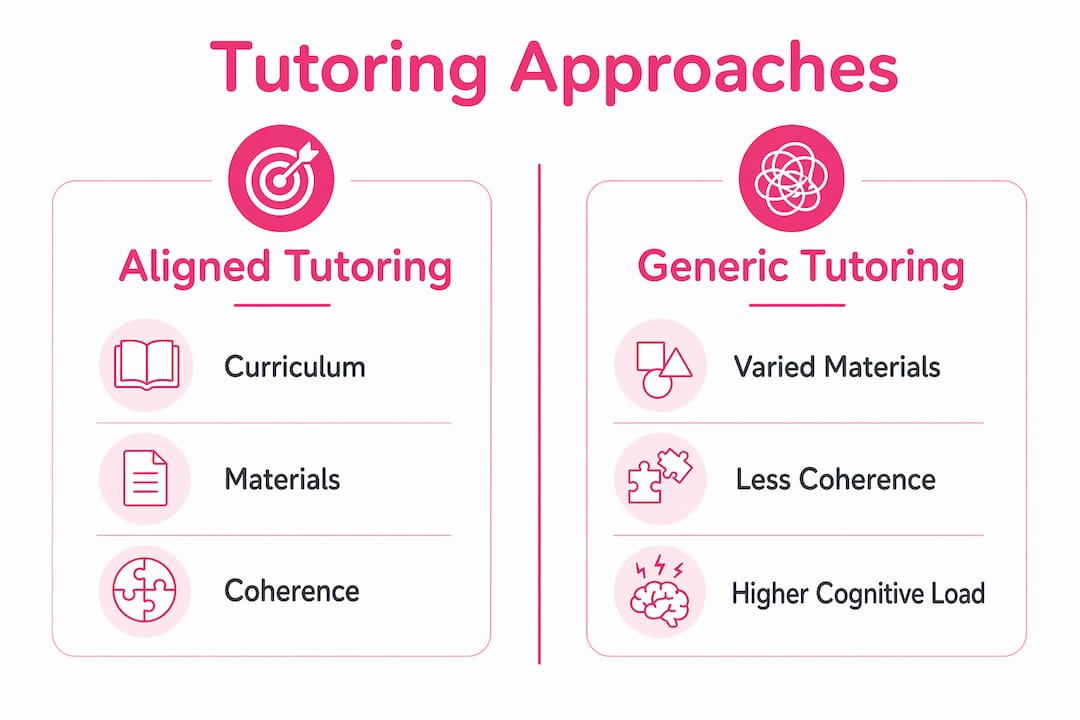
The table below shows the practical difference between aligned and generic tutoring approaches.
| Factor | Aligned tutoring | Generic supplemental tutoring |
|---|---|---|
| Materials used | Mirrors classroom curriculum (e.g., Benchmark Advance) | Off-the-shelf workbooks or unrelated resources |
| Cognitive load | Lower, because explanations match classroom instruction | Higher, because student reconciles conflicting methods |
| Learning gains | Up to 1.3 additional months of progress | Baseline improvement, often inconsistent |
| Gap closure speed | Faster, targets course-specific objectives | Slower, addresses general skill areas |
| Confidence impact | Stronger, student sees direct connection to class | Weaker, student may struggle to transfer skills |
Curricular coherence reduces cognitive load because you are not translating between two different frameworks. When your tutor uses the same notation, terminology, and problem structure your teacher uses, every session directly reinforces what happened in class that week. Structured tutoring programs with trained tutors, aligned materials, frequent sessions, and progress monitoring consistently close course and skill gaps, a finding validated by Stanford’s National Student Support Accelerator.
How session frequency and group size determine your progress
How often you meet with a tutor and how many other students are in the room are not logistical details. They are the two variables most likely to determine whether your gaps actually close.
High-dosage tutoring, defined as three or more sessions per week, produces measurably different outcomes than once-a-week check-ins. A District of Columbia initiative that served 5,135 students found that high-dosage tutoring improves attendance and engagement, with students averaging 27 sessions over the school year. More sessions mean more opportunities to practice a skill, catch errors, and build the repetition that converts short-term understanding into durable mastery.
Group size matters just as much. Groups larger than four students dilute the individualized feedback that makes tutoring different from a classroom. In a group of eight, your tutor cannot catch the specific moment you misapply a formula or misread a word problem. In a group of two or three, that moment is visible and correctable in real time.
Here is what to look for when evaluating any tutoring arrangement:
- Session frequency: Aim for at least three sessions per week for active gap closure, not one session per week for maintenance.
- Group size: One-to-one is most effective. Small groups of two to four students are a strong alternative when one-to-one is not affordable.
- Session duration: Shorter, more frequent sessions outperform long, infrequent ones for building procedural fluency.
- Scheduling consistency: The same days and times each week reduce the cognitive overhead of context-switching and build routine.
- Program duration: Full planned duration of tutoring, at minimum a full semester and ideally a full academic year, is needed for durable academic gains.
Pro Tip: If budget limits you to one session per week, use Jumpstudyai between sessions to practice the exact concepts your tutor covered. Spaced repetition between live sessions dramatically increases retention.
How tutors correct misconceptions before they compound
A misconception left uncorrected does not stay small. In math and science especially, one wrong mental model blocks every concept that builds on it. A student who misunderstands how to isolate a variable in algebra will carry that error through every equation in chemistry, physics, and statistics.
Individual attention in tutoring uniquely enables immediate correction of misconceptions, adapting pace to a student’s needs more effectively than any classroom setting can. Here is how that process works in practice:
- The tutor poses a problem and observes the student’s process, not just the answer. Watching how you work reveals where the logic breaks down, not just that it broke down.
- The tutor identifies the specific misconception through targeted questioning. Socratic prompts like “Why did you multiply here?” expose the underlying assumption rather than just marking the answer wrong.
- The tutor corrects the misconception with a direct explanation tied to the course’s framework. This is where curricular alignment matters again. The correction uses the same language and method your teacher uses.
- The student immediately practices the corrected approach on a similar problem. One explanation without practice does not fix a misconception. Guided practice within the same session does.
- The tutor reassesses at the start of the next session to confirm the correction held. Memory consolidation happens between sessions, so re-testing at the next meeting confirms whether the fix is durable.
This five-step cycle is what separates tutoring from self-study. You can read a textbook explanation of your error. You cannot get a textbook to watch you work, catch the exact moment your reasoning goes wrong, and adjust its explanation to your specific misunderstanding.
Best practices to maximize tutoring impact on your gaps
Getting a tutor is step one. Getting the most out of every session requires deliberate preparation on your end.
- Request a diagnostic before the first instructional session. Ask your tutor to assess your current standing relative to your course’s learning objectives, not just your general skill level.
- Bring your actual course materials. Your syllabus, graded tests, and current homework assignments give your tutor a precise map of what your course demands and where you are falling short.
- Ask for curriculum-aligned practice problems. If your class uses a specific textbook or method, your tutor’s practice problems should mirror that format, not a different one.
- Schedule sessions consistently and protect that schedule. Skipping sessions or rescheduling frequently breaks the instructional continuity that makes tutoring effective.
- Request a reassessment after every major topic. Before moving to the next concept, confirm with your tutor that you have actually mastered the current one, not just understood it once.
- Use Jumpstudyai between sessions. The platform’s adaptive step-by-step tutoring lets you practice the exact concepts from your last session, reinforcing them before the next one.
The students who close their gaps fastest treat tutoring as a system, not a service. They come prepared, they ask specific questions, and they practice between sessions.
Key takeaways
Targeted tutoring closes course-specific gaps fastest when it combines diagnostic assessment, curriculum-aligned materials, high-frequency sessions, and small group or one-on-one instruction sustained over a full semester or longer.
| Point | Details |
|---|---|
| Diagnostics first | Always start with a course-aligned assessment to identify the exact skills blocking your progress. |
| Aligned materials matter | Tutoring with curriculum-matched materials produces up to 1.3 additional months of learning gains. |
| Frequency beats duration | Three or more sessions per week outperforms one long weekly session for closing skill gaps. |
| Group size is critical | Keep tutoring groups at four students or fewer to preserve the individualized feedback that drives gap closure. |
| Sustained duration required | A minimum of one full semester of consistent tutoring is needed for durable academic improvement. |
What most students get wrong about tutoring
I have watched students cycle through tutors for months without closing a single meaningful gap, and the pattern is almost always the same. They treat tutoring as a homework help service rather than a targeted remediation process. They show up without their course materials, they let the tutor pick the topics, and they skip sessions when life gets busy. Then they wonder why their grade did not move.
The research on this is unambiguous. Sustaining high tutoring dosage with scheduling and logistic discipline is often the hardest but most critical factor in closing gaps. That is not a school administration problem. For you as a student, it means protecting your tutoring schedule the same way you protect an exam date.
The other thing students consistently underestimate is how early they need to start. A gap that forms in week three of a semester is manageable. The same gap in week ten, when three more units have been built on top of it, requires twice the work to close. Early intervention is not a luxury. It is the difference between a tutoring program that takes four weeks and one that takes four months.
My honest recommendation: find a tutor who asks to see your syllabus before your first session. That single behavior tells you they understand what course-specific gap closure actually requires.
— Jacob
Close your gaps faster with Jumpstudyai
Jumpstudyai is built specifically for students who need more than a generic explanation. The platform’s AI math tutor and AI physics tutor run adaptive diagnostics, then walk you through problems step by step using the methods your course actually teaches. You can upload your own notes and assignments so every practice session targets your real gaps, not a textbook’s idea of what you might be missing. Spaced repetition and ongoing reassessment confirm mastery before you move on. Whether you use Jumpstudyai as your primary tutor or as the practice layer between live sessions, it keeps your learning moving in the right direction. Start with Jumpstudyai and see exactly where your gaps are.
FAQ
What does course-specific tutoring actually mean?
Course-specific tutoring targets the exact skills and knowledge gaps tied to a student’s current class, using that course’s materials and methods rather than generic review content. This alignment is what separates effective gap closure from general academic support.
How many tutoring sessions per week do I need to close a gap?
Research on high-dosage tutoring defines effective frequency as three or more sessions per week. One session per week can maintain understanding but rarely closes a significant skill gap within a single semester.
Does group tutoring work as well as one-on-one?
One-to-one tutoring yields the strongest results, but small groups of two to four students remain effective because the tutor can still provide individualized feedback. Groups larger than four significantly reduce the personalized attention that drives gap closure.
How long does it take tutoring to close a course-specific gap?
A minimum of one full semester of consistent, high-frequency tutoring is needed for durable academic gains. Gaps that have compounded over multiple units may require a full academic year of sustained instruction.
Can AI tutoring tools replace a human tutor for filling learning gaps?
AI tutoring platforms like Jumpstudyai are most effective as a supplement to live tutoring, providing adaptive practice and reassessment between sessions. For students who cannot access live tutors, a well-designed AI tutor with diagnostic and curriculum-aligned features can close many course-specific gaps independently.